
ABOUT US
IRELAC, “Institut Interdisciplinaire pour les Relations entre l’Union Européenne, l’Amérique Latine, l’Afrique et les Caraïbes” (Interdisciplinary Institute for the Relations between the European Union, Latin America, Africa, and the Caribbean) is an independent Thinktank.
IRELAC is a non-profit research organization, ruled under Belgian law, open to universities, research organizations and individual experts in Europe, Latin America, Africa, and the Caribbean, with the view to form a complementary interdisciplinary team and network of experts in analysing systemic issues. Its experiences cover more than 40 years of analyses, consulting services, missions, and academic events.
IRELAC usually works as an expert in consulting projects with the EU, the UN (Economic Commission for Latin America and the Caribbean, ECLAC/CEPAL), the EU-LAC Foundation (Hamburg), the Belgian Ministries, the Conference of Italian Rector (CRUI), ECOSUR Colegio de la Frontera de Sur, Mexico, chambers of commerce, key Latin American organizations, or countries as well as African ones, and is usually co-organizer of seminars and events in Brussels, in Latin America and in Africa.
IRELAC and El Colegio de la Frontera Sur (ECOSUR) Mexico, signed in March 2022, a collaboration agreement that establishes the bases of cooperation between both institutions in relation to higher academic education, research, and innovation in the economic-social, ecological, scientific, technological, political, and cultural developments.


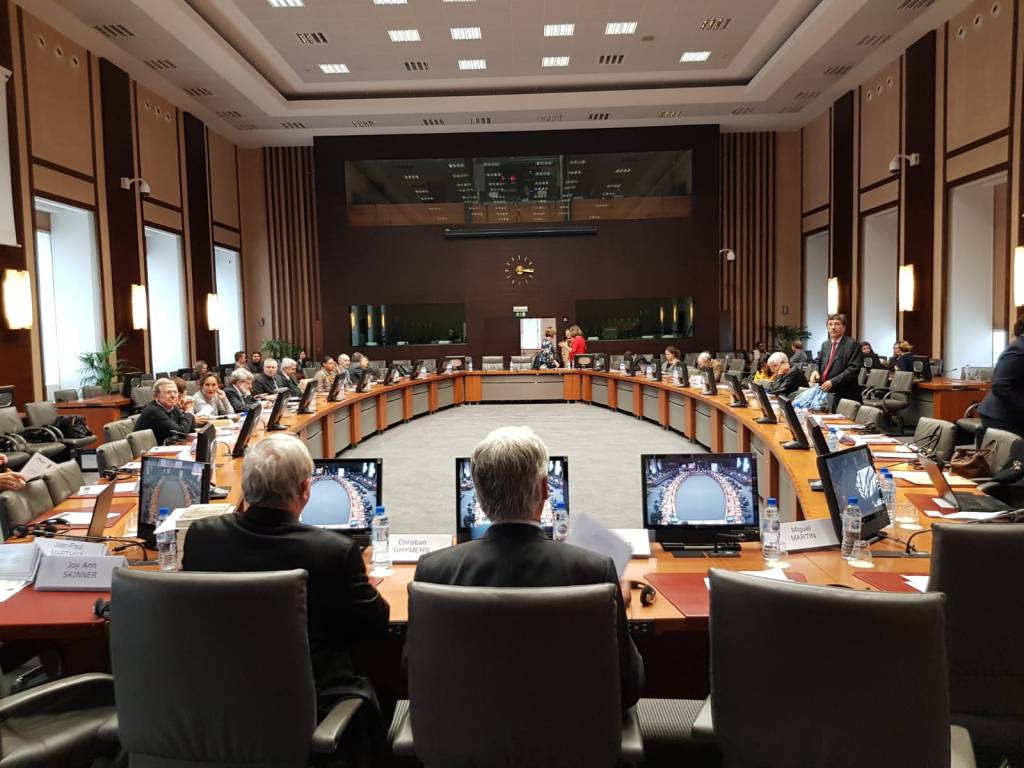
OUR EXPERTISE
IRELAC gathers leading international experts from a wide range of disciplinary backgrounds. Our experts have years of practical and academic experience in the relations between Europe, Latin America and the Caribbean, and Africa. Our experts work on academic cooperation issues, on regional integration, macroeconomic, geopolitics, social analysis, crisis management, diplomacy, science, technology, innovation, and gender issues.
Its members form a complementary interdisciplinary team of experts in analysing the relations and cooperation between the European Union, Latin America, Caribbean and Africa. It provides an experimented expertise and analytic capacity on socio-economic and policy-oriented issues, especially on the processes of regional integration, local development and innovation, social inclusion, and macroeconomic situation of each country, focusing on the interplay of economic, political, social, and environmental issues.
IRELAC provides consultancy services to African regional and locally based institutions such as IGAD (The Intergovernmental Authority on Development) in Eastern Africa composed by eight member states.
OUR PURPOSE
IRELAC is dedicated to the academic relations and cooperation between the European Union, Latin American and Caribbean, and African regions. It provides an experimented expertise and analytic capacity on socio-economic and policy-oriented issues, especially on the macroeconomic development of the regions and each of their countries, the processes of regional integration, local development, social inclusion, and gender issues, focusing on the systemic interplay between economic, political, social, and environmental issues.
IRELAC organizes research and seminars related to systemic issues and addresses an audience of post-graduate students, researchers and academic experts, international officials from the European Union Institutions (European Commission, European Parliament, and European External Action Service), from the UN (ECLAC, IMF, WB, WTO), from Latin America and the Caribbean, from Africa, as well as diplomats and national experts from these three regions.
IRELAC works as an expert organisation in consulting projects with the EU, the UN (Economic Commission for Latin America and the Caribbean, ECLAC/CEPAL), the EU-LAC Foundation (Hamburg), the Belgian Ministries, the Conference of Italian Rector (CRUI), chambers of commerce, some Latin American organizations, or countries as well as African ones, and is usually co-organizer of seminars and events in Brussels, in Latin America and in Africa.
.
PARTNERS

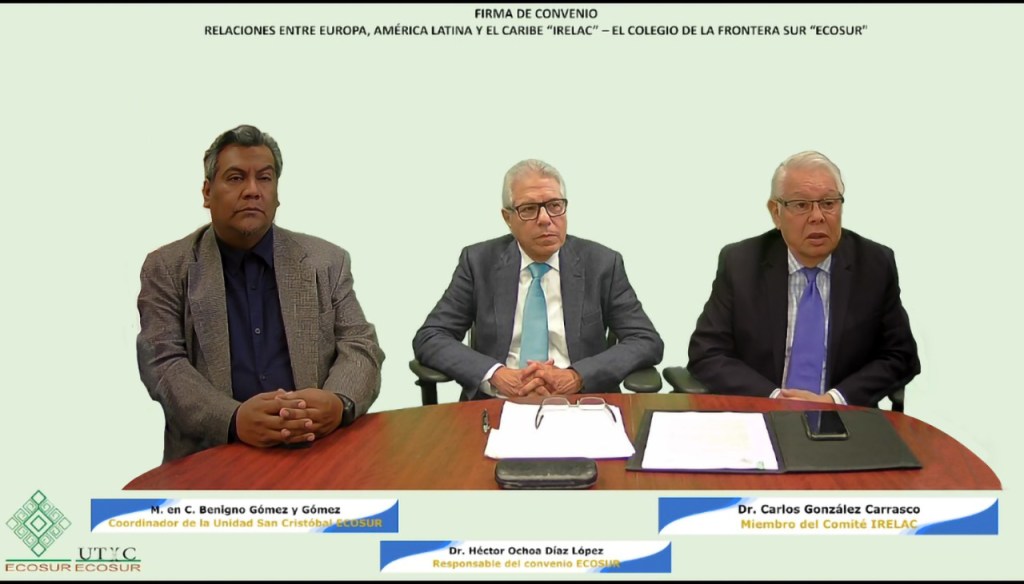
IRELAC and El Colegio de la Frontera Sur (ECOSUR) Mexico, signed a collaboration agreement that establishes the bases for cooperation between both institutions in relation to higher academic education , research and innovation at the economic-social, ecological, scientific, technological, political, and cultural levels.
Dr. María del Carmen Pozo de la Tijera, general director of ECOSUR, pointed out that this agreement aims to train high-level human resources in higher education and carry out joint research and that it will allow the link between Europe and Latin America. and Central America, in areas of interest such as public health, migration, climate change, eco-sustainable economy and economic policies, democratic institutions and political movements, educational innovation, clean technologies, and new science – ecohuman transformational . She pointed out that ECOSUR has always been interested in addressing these problems from a multi and interdisciplinary point of view.
Dr. Christian Ghymers Hanot, president of the IRELAC Committee, stated that a bi-regional cooperation between Europe and Latin America and the Caribbean, is essential for meeting the present challenges that both regions face for ensuring a sustainable socio-economic development. In particular, both regions share common view on the need for conciliating growth, equity, and respect of environment. In order to reach this common objectives, inter-regional cooperation could improve significantly in both regions their governance and speed-up innovation, productivity, and their respective ascension into the ladder of international specialization and human development.
Both IRELAC and ECOSUR are experienced institutions in higher education, research, and innovation. They present complementary endowments for working together in areas such as socio-economic stability, productivity, climate change, sustainable development, peace, security, and human rights. In the field of higher education, research and innovation, there are a series of programs and initiatives between both regions, so from this perspective an agreement between IRELAC and ECOSUR can contribute to the transformation of a new human, political and cultural development in both regions.
IRELAC and RIDH (Red Internacional de Derechos Humanos, Belgium) signed a collaboration agreement. RIDH focus on the promotion and protection of human rights in Latin America and the international human rights system before the United Nations and the European Union.
IRELAC and RIDH focuses in the following areas. Promote mediation between different actors, especially through dialogue for Human Rights in Latin America. Facilitate a temporary physical space for scholarship holders who work for IRELAC. Foster respect for cultural diversity, integration, and rapprochement of cultures, countries, races, or religions, for the defense and promotion of Human Rights and for the construction of Peace. Promote values and attitudes towards social change, based on criteria of Justice, Peace, Equity, Equal Rights and Opportunities between Women and Men, Democracy, Participation, Solidarity and Care of the Environment.
Website: www.ridh.org

EGMONT – The Royal Institute for International Relations is an independent think-tank based in Brussels. Drawing on the expertise of its own research fellows, as well as that of external specialists, both Belgian and foreign, it provides analysis and policy options that are meant to be as operational as possible.
IRELAC has been associated with Egmont since 2014, with which it is co-organizing researches and seminars related to the academic and scientific cooperation with the CELAC region, and in particular ensures the follow-up of the bi-regional Academic Summit held in Brussels and in Egmont in June 2015 with an informal Think-tank on Innovation and Science Diplomacy with Egmont and the Belgian Federal Science Policy Office as well as on Social and Solidary Economy with the Belgian association “Pour la Solidarité”.
Website: www.egmontinstitute.be

ICHEC is a “Haute Ecole” in economy and management.
ICHEC enables its students to develop their talents and educates them to become responsible as well as open-minded managers.
In order to accomplish this mission, ICHEC adopts a rigorous approach to its academic programs, informed by research, with an emphasis on business practice. Their graduates gain the knowledge, skills and competences which are necessary to embark on a lifelong learning process.
The ICHEC spirit is founded on the values of respect, solidarity, and integrity.
Website: www.ichec.be
BOARD MEMBERS
Christian Ghymers Hanot, President, Professor ICHEC-Brussels School of Management, past-adviser European Commission, independent Consultant
Fernando Avila Maldonado, Political Scientist, Consultant-Expert for territorial development
Etienne Cracco, Professor ICHEC-Brussels School of Management and ESAN-Peru
Thierry Dumoulin, Administrator, Honorary Consul for Chile in Wallonia
Geneviève François, Administrator, Coordinator, Honorary Delegate of the “Wallonie-Bruxelles Federation” and “Wallonia Region”
Carlos González Carrasco, Author, New Science, Sistema Sapien, Human Conductivity. Visiting Research Professor, ECOSUR, Mexico
Electra Lagos. Consultant, Director of REDHA, Project Manager EU-CELAC
Ricardo Silva Escudero, Administrator, Lawyer, PhD in Political Science
Frank Van de Craen, Honorary Ambassador of Belgium
SCIENTIFIC COMMITTEE
Claudio Dondi, Economist, Expert on higher education
Christian Ghymers Hanot, Economist, Professor of International Economics at ICHEC-Brussels Management School, Vice-President of the Robert Triffin International Association, Administrator of the Belgo-Chilean Chamber of Commerce
Carlos González Carrasco, Author, New Science, Sistema Sapien, Human Conductivity. Visiting Research Professor, ECOSUR, Mexico
Stéphanie Griffith Jones, Board Member of the Central Bank of Chile, Columbia University, New-York
Domingo Lillon, Professor Universidad de Pest, Hungria
Dr. Héctor Ochoa Diaz-López (tbc), Medical Surgeon, (Faculty of Medicine, UNAM). Master of Science in Social Medicine (MSc.) and Doctor of Philosophy (PhD) in Epidemiology (London School of Hygiene and Tropical Medicine). Researcher in epidemiology and health systems at El Colegio de la Frontera Sur (ECOSUR)
TEAM
Christian Ghymers – President of IRELAC, Economist, Professor of International Economics at ICHEC-Brussels Management School, Vice-President of the Robert Triffin International Association, Administrator of the Belgo-Chilean Chamber of Commerce. Past-adviser to the Economic and Financial Affairs Directorate General at the European Commission, Past-Adviser to the Economic Commission for Latin America and the Caribbean (ECLAC/CEPAL) in Chile (2000-2004). Before, he used to be Adviser at the National Bank of Belgium, Professor at the University of Louvain-la-Neuve, University of Aix-Marseille II, University of Lille, University of Chile. Contact: ch.ghymers@irelac.org
Geneviève François – Coordinator of IRELAC, she is the Honorary Delegate of the Wallonia-Brussels Federation and the Wallonia Region. In particular, she opened the Wallonia-Brussels Delegation in Chile in 2004. She is past-Director of the Belgo-Chilean Chamber of Commerce. Contact:
Antoine Masquelin – Project Manager, he holds a Master’s Degree in Population and Development Studies (Louvain la Neuve – Belgium) and is specialized in the field of social economy. He is also Project Manager in the European think & do tank Pour la Solidarité in Brussels. Contact: a.masquelin@egmontinstitute.be
Diego Cerda Seguel, Sociologist, scientist and author on political theory, epistemology, technology. Develops the concept of social geosemantics (s. 2005). Director of Endogenous Technological Development Processes at Qultar App, a Colombian based local-global social network. Contact: diego.cerda.s@gmail.com
Carlos A. González Carrasco, visiting research professor ECOSUR, Mexico. (New Science). With 25 years of scientific research, practical global corporate experience and business development. He works as an international expert consultant, organisational and executive coach. Contact: c.carrasco@irelac.org
Claudio Dondi – Project Manager, expert in the fields of higher education, international relations, eLearning, professional training, quality and social inclusion, innovation, and local development. He facilitates collaboration between the EU and LAC in the areas of research, education, innovation, and regional development. Contact:
Fernando Avila Maldonado, he is a political scientist, expert-consultant in decentralized international cooperation. Contact:IRELAC also hires interns on a regular basis. Interns are deeply integrated into all aspects of the organization.




 IRELAC
You must be logged in to post a comment.